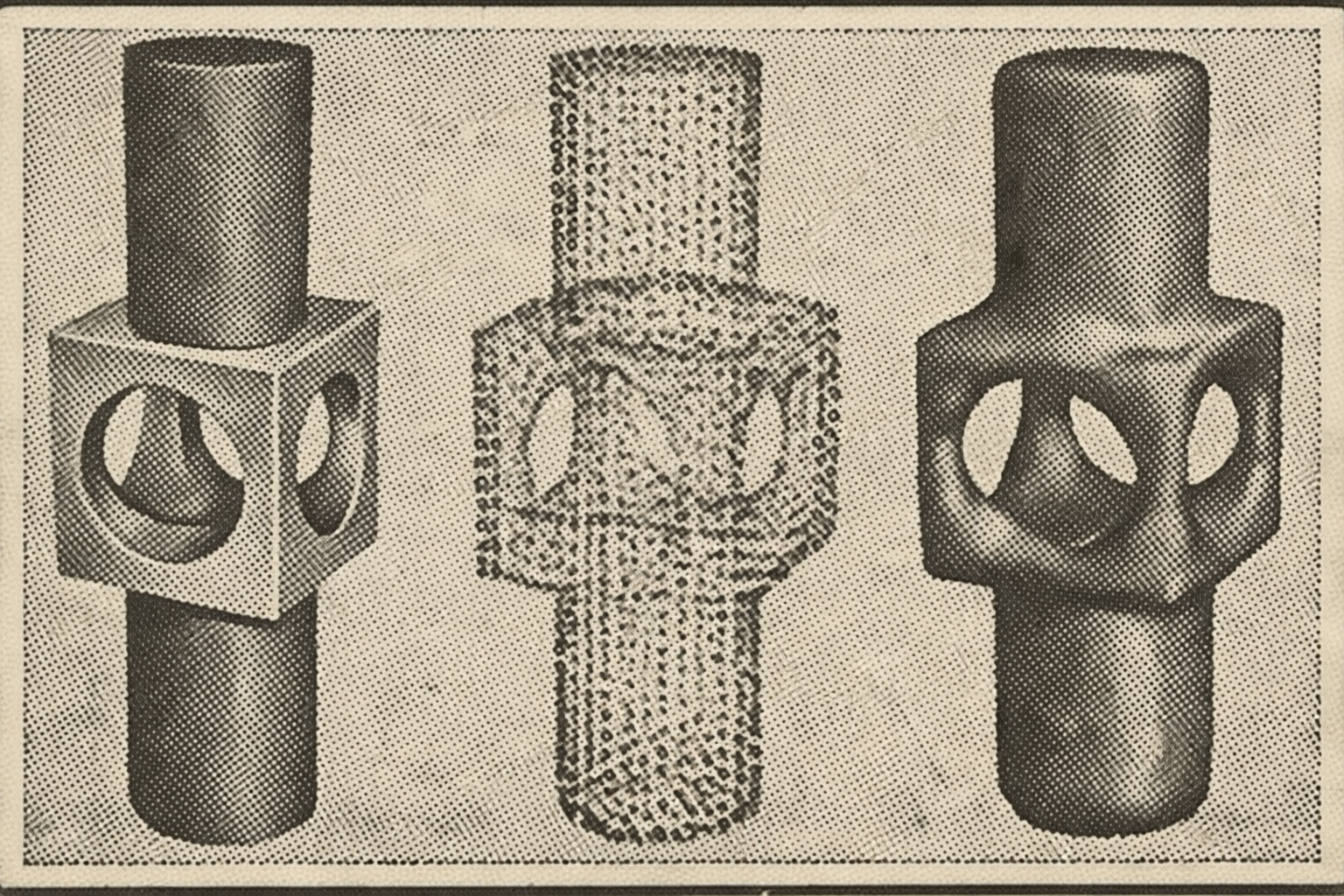
Five brave investigators (Hugues Hoppe, Tony DeRose, Tom Duchamp, John McDonald, and Werner Stuetzle) have published a paper that may reshape the landscape of surface reconstruction. The work, which has been circulating in preprint form among computer graphics departments, describes a novel method for inferring surfaces from unorganized point sets, a problem that has long vexed practitioners in the field. The team of authors claims that their approach, which combines normal estimation, denoising, implicit fitting, and contour extraction, is able to summon once thought irretrievable surfaces with outstanding fidelity and robustness. But their most striking assertion is that the method can handle the most unruly of point clouds, those that are non-uniformly sampled and contaminated by moderate noise, without succumbing to the usual pitfalls of spurious handles, collapsed patches, and ragged boundaries.
When the evidence is incomplete, reconstruction becomes interpretation.
In this report we will uncover the true surface of the matter. Let us methodically judge the claims, examine the evidence, and weigh the method's results. Science shall always prevail over speculation and hyperbole!
According to the manuscript that has reached our desk, the method's key contribution is a new pipeline that integrates local structure estimation with a global orientation fitting procedure. This combination is what allows the algorithm to gracefully handle the twin challenges of non-uniform sampling and moderate noise, provided that said samples are not too sparse and said noise is not too extreme.
This approach stands in contrast to prior methods that have historically been able to act only on structured data. Regrettably, dear reader, life is not always so kind to us scientists! Many industry devices, such as laser range and mechanical scanning systems, produce data that is often irregular and noisy, and where no guarantees can be made about the underlying distribution. The new method's ability to operate under these conditions, if the claims hold, would represent a significant advance in the field, potentially opening the door to more reliable reconstructions from real-world scans.
"We do not merely connect points; we infer the shape that would have explained their arrival."
The proposed method proceeds in two principal stages, each of which conceals a surprising degree of subtlety. First, the algorithm attempts to understand the surface locally. Each point in the cloud is surrounded by its nearest neighbors, and from this small society of points a plane is fitted using our old friend, the least squares method.
This step yields both a center and a normal vector for each point. However, the process is not without its challenges. The choice of neighborhood size is critical: too small, and the estimate becomes dominated by noise; too large, and it may smooth over important features. Sadly, the choice of the ideal neighborhood size is not explored fully and a method to automatically select it only hinted at. Will future work be able to resolve this conundrum? Maybe one day, but for now, it remains a dream blurred in clouds of uncertainty.
But then comes the true difficulty: orientation. A plane, after all, has two sides. Which one is outward is not the right question; the real question is how to ensure that all points agree on their choice! The authors concede that determining a globally consistent orientation across all points is no trivial matter, in fact, in its pure form, it borders on the computationally infeasible. And so, the method proceeds not with certainty, but with a carefully chosen approximation, propagating orientation across a network of neighboring points in what the authors term a “Riemannian Graph.”
“We choose to believe the surface is there... because the alternative is chaos.”
Once these local fragments have been aligned into a coherent whole, the second stage begins. Here, the algorithm constructs what is known as a signed distance function, a mathematical device that assigns to every point in space a value indicating how far it lies from the surface, and on which side. The surface itself is then defined as the set of points where this value vanishes. Our most faithful readers will rapidly recognize this representation from our past numbers!
It is, in effect, a ghostly reconstruction: the surface is not explicitly drawn, but inferred as the invisible boundary between positive and negative space. But do not be afraid from otherwordly terms! This implicit description is a most powerful one, as contouring procedures have long been studied in order to extract meaning hidden behind the veil of the mathematical abstraction. As such, a mesh is finally extracted using a contouring procedure, one that marches through space, cell by cell, stitching together a tangible surface from the abstract field. And, as our dear readers might have already guessed, this is indeed, marching cubes!
The results, as presented, are undeniably striking. Objects of considerable geometric complexity, mechanical parts riddled with holes, knotted structures of intricate topology, and even anatomical forms derived from medical scans, are reconstructed with apparent fidelity. In several cases, the method recovers not only the shape, but also the correct topological structure, including handles and boundaries.
Particularly noteworthy is the method's handling of incomplete data. Where earlier approaches might falter, producing fragmented or disconnected surfaces, this algorithm often succeeds in producing a continuous reconstruction, provided, of course, that the gaps are not too severe. The paper itself admits that large missing regions remain beyond its reach, a limitation that serves as both a caution and a quiet reassurance that not all mysteries are so easily resolved.
Yet one must examine these results with a careful eye. The number of figures and demonstrations is undeniable limited, and the question that lingers, like an unasked follow-up at a press conference, is how the method performs when the data is truly unruly, when noise is severe, sampling uneven, and structure ambiguous. Our reporters and readers
To see the most beautiful surfaces, one must fight against the most pathological topologies.
Buried within the technical details are several assumptions that merit attention. The method presumes that the underlying surface is sufficiently well-sampled, that no region is left entirely unobserved, and that the noise affecting the data remains within manageable bounds. Features smaller than this noise, the authors note, are simply irrecoverable.
Even the very notion of a boundary, where the surface ends, is inferred indirectly. Regions deemed too distant from reliable data are simply excluded, and from this exclusion the edge emerges. Whether that edge reflects reality, or merely the limits of observation, is a question the method (and the limited amount of figures...) does not answer.
And so we arrive at a curious conclusion. The method described is, without question, a remarkable technical achievement, one that unifies disparate reconstruction problems under a single, elegant framework and pushes the boundaries of what may be inferred from unstructured data.
Yet it is also a reminder that reconstruction is never a purely mechanical act. It is an interpretation, a negotiation between evidence and assumption, between what is measured and what is believed. The surfaces produced may be smooth, coherent, and compelling, but they are, in the end, products of both data and design.
"A surface, like life, finds a way."
Whether this new method represents a faithful lens onto reality or a particularly persuasive storyteller remains, perhaps fittingly, a matter for continued investigation. For now, the Chronicle shall watch closely as this technique makes its way from laboratory curiosity to practical instrument, and as its claims are tested against the untidy complexity of the real world.